
Home > Blog > News and Updates > What Really Happened to Domestika?

Inside Domestika’s Collapse: What Three Court Cases Reveal About the Platform’s Problems

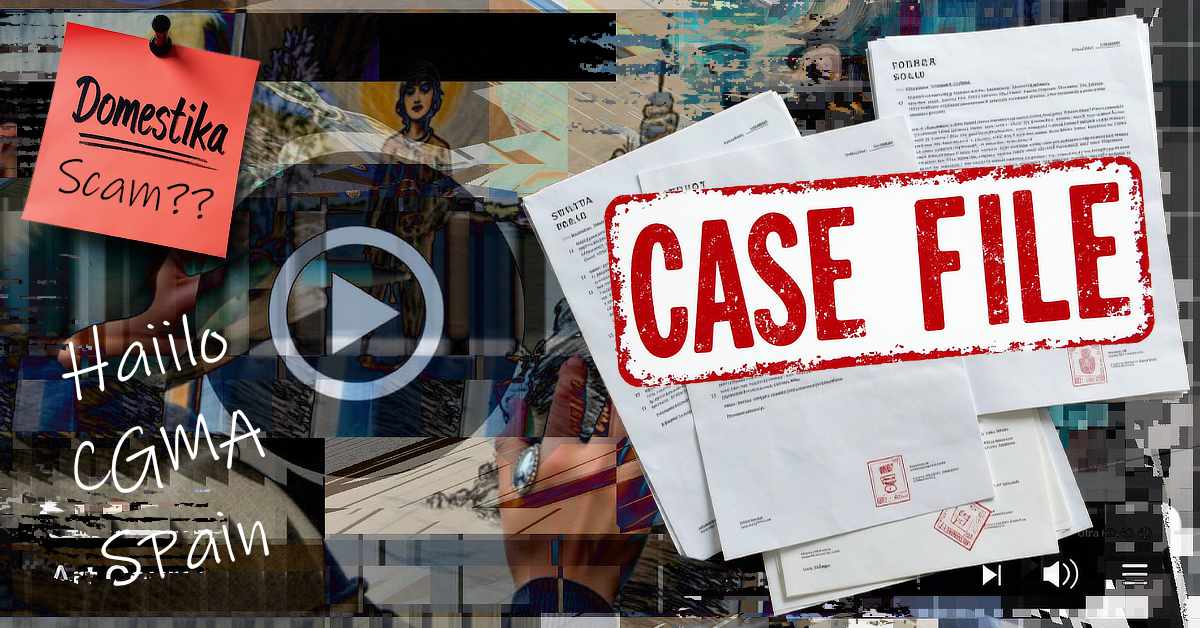
A collage-style image with documents labeled “CASE FILE” in bold red letters. A red sticky note reads “Domestika Scam??” in handwritten text. Background elements include distorted images of artwork, hands, and a large play button symbol, suggesting multimedia or investigative content.
A Haiilo breach of contract, the CGMA dissolution and a fraud case from Spain show the trouble with Domestika started years before the public collapse.

This is a follow-up to my first post about what’s been happening with Domestika. From instructors not getting paid, to students billed for subscriptions they didn’t sign up for, to employees facing sudden layoffs — the once-loved creative community turned art and design course platform is collapsing into controversy.

While researching what happened to Domestika, I found three separate court cases. I didn’t include them earlier because the post was long enough already, but together they paint a much clearer picture of why everything fell apart. One case involves Haiilo, a business administration software platform Domestika didn’t pay. Another comes from Spain, dating back to Domestika’s early years. And the last is a major case connected to the ongoing dissolution of CG Masters Academy (CGMA), which Domestika acquired.

The timeline these cases reveal shows that Domestika’s problems didn’t start in 2024 when the public finally noticed — the trouble began years earlier.

Court Cases? So Is Domestika Really a Scam?

No, Domestika is not technically a scam. But its administrative and financial systems appear to have broken down catastrophically under the pressure of rapid global expansion.

That doesn’t excuse the harm done to instructors, students, or employees. Domestika absolutely should have handled this situation more responsibly, communicated honestly, and protected the people who depended on them. Continuing to run business as usual without addressing people’s concerns is unethical, in my opinion.

For now, I still recommend avoiding signing up for anything until (or if) things get resolved. If you need a refund, go through your bank — Domestika’s internal support systems likely still aren’t functioning properly. You’ll see what I mean by that.

What the Court Cases Reveal About Domestika’s Collapse

These three cases show a recurring pattern of weak internal controls, administrative instability, and financial disorganization that worsened over time.

1. The Haiilo Lawsuit (2023): The First Public Red Flag

Two men in suits are having a serious discussion in a courtroom near the witness stand. One man leans forward with his hands on the table, while the other holds documents. The room features ornate wood paneling and a formal legal setting.
Haiilo sued Domestika for breach of contract.

(Case No. 23CV049281)

In October 2023, the software company Haiilo Inc. sued Domestika for $40,480 in unpaid invoices. Haiilo isn’t just any vendor — their platform handles:

  • internal communication

  • HR announcements

  • employee onboarding

  • company-wide updates

Domestika signed a contract with them in October 2021, then stopped paying by April 29, 2022 — the very same year Domestika raised a massive funding round and became a unicorn (1.3 billion dollar valuation).

Why Would a Company With Huge Funding Fail to Pay a $40k Bill?

Because venture funding doesn’t go into day-to-day operational expenses. It goes into:

  • hyper-growth

  • hiring

  • global marketing

  • acquisitions (like CGMA)

  • scaling content production

  • new markets

This burns cash extremely fast.

If internal administrative systems can’t keep up — or if the company grows faster than its accounting and HR teams can manage — even basic vendor payments begin slipping through the cracks.

The Haiilo lawsuit shows that Domestika’s internal communication systems were already breaking down in 2022, long before the public noticed any problems. Unpaid bills mean services stop working.

This lines up with employee reports from 2023–2024 about:

  • confusing management

  • lack of communication

  • disorganized workflows

  • vanishing support channels

Haiilo’s case is the earliest concrete sign that Domestika’s infrastructure was beginning to fail.

2. The CGMA Case (2025): A Chaotic Dissolution

Two men in suits are engaged in an intense conversation at a courtroom table. One man gestures emphatically with his hand while speaking, and the other listens attentively. A judge is blurred in the background, seated at the bench.
Domestika's ongoing messy dissolution of CGMA

(Case No. 25CV142605)

CGMA — a respected art school Domestika acquired — abruptly collapsed in 2024. Students were left with unfinished classes, and instructors reported missing payments. But the real story only appears in a petition Domestika filed in September 2025. This explains the legal notice on CGMA’s website.

According to the petition, Domestika is requesting:

  • a court-appointed receiver

  • a full accounting of CGMA’s finances

  • preservation of all records

  • authority to complete the winding-up of the dissolved company

This is serious. Companies only request a receiver when they can’t access financial records or when the dissolution has become too messy to handle internally.

CGMA’s Former Leadership Is Fighting Back

Former CGMA leaders — Emmanuel “Manny” Fragelus, Lilliams Garcia, and Ted Davis — filed formal oppositions and declarations disputing Domestika’s claims.

This suggests:

  • Domestika did not receive a clean transition

  • the financial records may be incomplete or inaccessible

  • the acquisition itself may have been poorly integrated

  • Domestika is unable to issue payments or refunds without those records

This legal fight directly connects to:

  • unpaid instructors

  • frozen student accounts

  • missing course data

  • inability to issue refunds

  • total communication silence

  • strange new CGMA course listings appearing long after the shutdown

The CGMA case shows the collapse wasn’t just financial — it was also bureaucratic. This case is still ongoing and will continue into at least 2026.

3. The Spain Case (2018): Early Warning Signs

A man in an orange prison jumpsuit sits at a courtroom table with his hands clasped, flanked by two men in suits. He looks directly ahead with a serious expression. The setting includes dark wooden panels in the background, indicating a formal courtroom.
A criminal fraud case in Spain where Domestika was the victim.

(SAP M 1032/2018 – Domestika Interactiva S.L. The Document is in Spanish.)

The last case dates all the way back to 2006–2008, long before Domestika became an international course platform.

In a Spanish criminal proceeding, the company’s early financial director was convicted of siphoning €177,359.66 (USD $205,195.37) from Domestika’s accounts over several years.
(See Hechos Probados / Proven Facts on page 2 in the document.)

Domestika was the victim in this case. But the important part is what it reveals:

Domestika has struggled with internal financial oversight for a long time.

Even in its early years as a small creative community, the company had:

  • weak controls

  • dependence on individual managers

  • lack of financial oversight

  • disorganized account handling

These weaknesses weren’t new — they only became more damaging as the company scaled globally.

In my opinion, this case shows that Domestika is not a scam. Having their former financial director charged with fraud would have opened up an investigation. That could have exposed everyone if the entire company was a scam. Scammers will do everything they can to avoid getting caught.

A Pattern Becomes Clear

When you put all three cases together, the pattern is striking:

2006–2008 (Spain):

Internal financial checks fail. Money is siphoned out without detection.

2021–2022 (Haiilo):

Hyper-growth overwhelms operations. A $40k software bill goes unpaid while the company announces unicorn status.

2023–2024:

Internal communication collapses. Payment issues explode. Refunds stop. Staff are left confused.

2025 (CGMA):

Domestika can’t even access the financial records of a company it owns. A court has to step in.

Across almost twenty years, the same themes repeat:

  • administrative overwhelm

  • weak operational infrastructure

  • disorganized accounting

  • poor transitions

  • internal communication failures

  • financial mismanagement

  • massive growth without adequate support systems

Domestika didn’t intend to deceive people — but its internal structure was never strong enough to support the scale it grew into.

Conclusion: Why Transparency Matters Now More Than Ever

Domestika’s collapse wasn’t sudden. These court cases reveal a long history of internal instability that worsened dramatically during global expansion. Students, instructors, and employees were left without answers because Domestika wasn’t able — or willing — to explain what was happening inside the company.

These records bring much-needed clarity. They show where things started breaking down and why so many people were harmed in the process. They also illustrate how fragile creative-tech companies can be when their internal systems don’t scale with their ambitions.

My hope is that sharing this information helps others stay informed, recognize warning signs, and protect themselves in the future. Transparency is vital — especially in creative industries where so many people rely on platforms like Domestika to learn, earn, and connect.

And if Domestika ever recovers, I hope they rebuild with honesty, accountability, and the respect their community deserves.

Write for Art & Design by Teresa Cowley! Submit your guest post or sponsored collaboration idea on art, design or the creative industry. Share your expertise with a global community of artists and designers.

More from Art and Design By Teresa Cowley
This image features two women in an art gallery. The woman on the left has long, wavy brown hair, green eyes, and a mildly uncomfortable expression. She is wearing a light green tank top. The woman on the right has long, straight black hair, large brown eyes, and is smiling confidently with bright red lipstick. She is dressed in a red long-sleeved shirt. The background includes framed sculptures and artwork on the walls. The image emphasizes exaggerated facial expressions characteristic of animated characters.
Art and Design LOLs - Part 1
Dive into the whimsical world of art and design with hilarious letters and witty responses! From missing...
A Model Wearing the Purple Bandana Florals in Digital Lavender Pattern Trend
The Fabulous Fall/Winter Pattern Trends 2023/2024
Get inspired with my latest blog post exploring the Fabulous Fall Winter Pattern Trends for 2023/2024!...
Two young women are sitting at a table, smiling while looking at a laptop screen. One woman is wearing a denim jacket over a white shirt, while the other is dressed in a mustard yellow blazer over a black top. The background features a vibrant, colorful wall with an abstract tropical design, including large leaves, circles, and dotted patterns in shades of orange, blue, and yellow. A glass with pencils and a small potted plant are on the table.
Guest Posts and Fresh Perspectives
Big changes are coming to the Art & Design By Teresa Cowley blog in 2025! With a new flexible posting...

Digital artist and graphic designer, Teresa Cowley

My name is Teresa Cowley, and I'm a digital artist and graphic designer from Vancouver Island, Canada. I focus on abstract and fantasy art as well as digital collage, and like to utilize AI art tools as part of my design process to create new, innovative pieces of art. I strive to create new, unique designs that tell imaginative stories, and I am eager to push the boundaries of what can be expressed with art and technology.

0 Comments

Leave a Reply

Avatar placeholder

Your email address will not be published. Required fields are marked *