
The Domestika Plus Review Files – Part 1: Public Statements vs. Website Behaviour
Consumer protection isn’t my primary focus. But when a major creative platform fails to clearly address ongoing concerns about its subscription model, careful documentation becomes necessary.
I’ve previously written about Domestika and its Plus subscription. This series takes a more structured approach — examining public statements, website behaviour, purchase flow mechanics, and communication patterns to bring clarity where confusion persists.
Each installment focuses on observable evidence and documented behaviour, not speculation.
How Domestika Describes the Plus Subscription Compared to How the Purchase Flow Actually Works
Evidence Note: All observations described in this article are based on documented purchase flow testing, screenshots, and publicly visible website behavior.
Over the past two years, Domestika has publicly addressed concerns about its Domestika Plus subscription. In various comments and support responses, the company has suggested that misunderstandings about the subscription largely stem from user confusion during the purchase process.
But when comparing these public explanations with the actual behavior of the website, a more complicated picture begins to emerge.
This post examines that gap.
Rather than focusing on individual complaints, this review looks at observable platform behaviour — including how the checkout flow presents Domestika Plus during course purchases.
Domestika’s Public Position
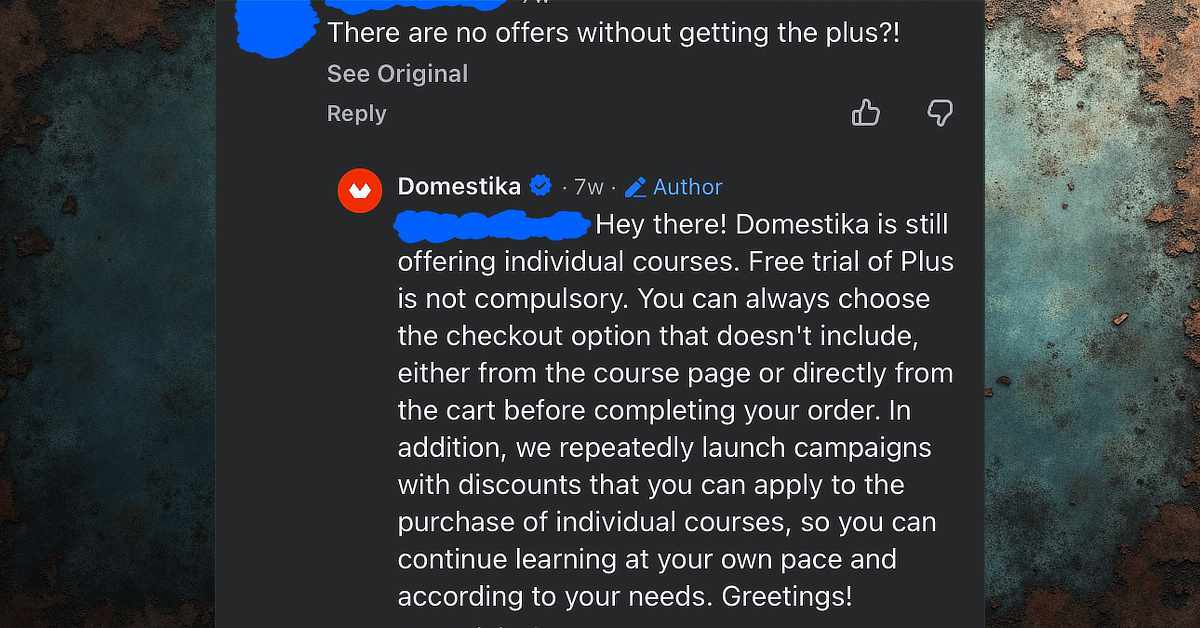
The following screenshots are public replies to comments left on two separate Facebook ads ran by Domestika.
This comment and reply were originally in Spanish.
Question: “There are no offers without getting the plus ?!”
Domestika’s answer: “Hey there! Domestika is still offering individual courses. Free trial of Plus is not compulsory. You can always choose the checkout option that doesn’t include, either from the course page or directly from the cart before completing your order. In addition, we repeatedly launch campaigns with discounts that you can apply to the purchase of individual courses, so you can continue learning at your own pace and according to your needs. Greetings!”
Here’s another public comment and reply on one of Domestika’s Facebook ads:
Comment: “99p for a 30 day trial then £22 a month.”
Domestika’s reply: “Hi! Courses payment is one-time only and gives you full access to
the content, with no expiration date. When you purchase your course(s), you can
choose to pay the regular price for the single course, or discounted price along
with the free trial of the Domestika Plus subscription, which has an annual fee. See you in class!”
In response to complaints about unexpected charges related to the Domestika Plus free trial, Domestika has stated that:
The platform frequently runs discount campaigns for individual courses
The Plus subscription is clearly explained during the purchase process
Users agree to the free trial terms during checkout
On the surface, this explanation suggests a straightforward situation: discounted courses are separate from the subscription, and the trial is clearly communicated.
Public Statements vs Observed Behaviour Table
When comparing public explanations with the actual purchase flow, several structural differences become visible.
| Domestika Public Statements | Observed Website Behavior |
|---|---|
| Discounts primarily apply to individual courses | Course purchases often introduce a Plus trial in the same checkout flow |
| Users agree to the trial during checkout | Trial appears as a separate cart item |
| Subscription terms are presented during purchase | Promotional sales messaging dominates the purchase interface |
| Course discounts are highlighted in promotions | Trial and course purchase may appear together as transactional items |
Examining the purchase flow more closely reveals design choices that blur the distinction between explanations and website behaviour.
How the Purchase Flow Actually Works
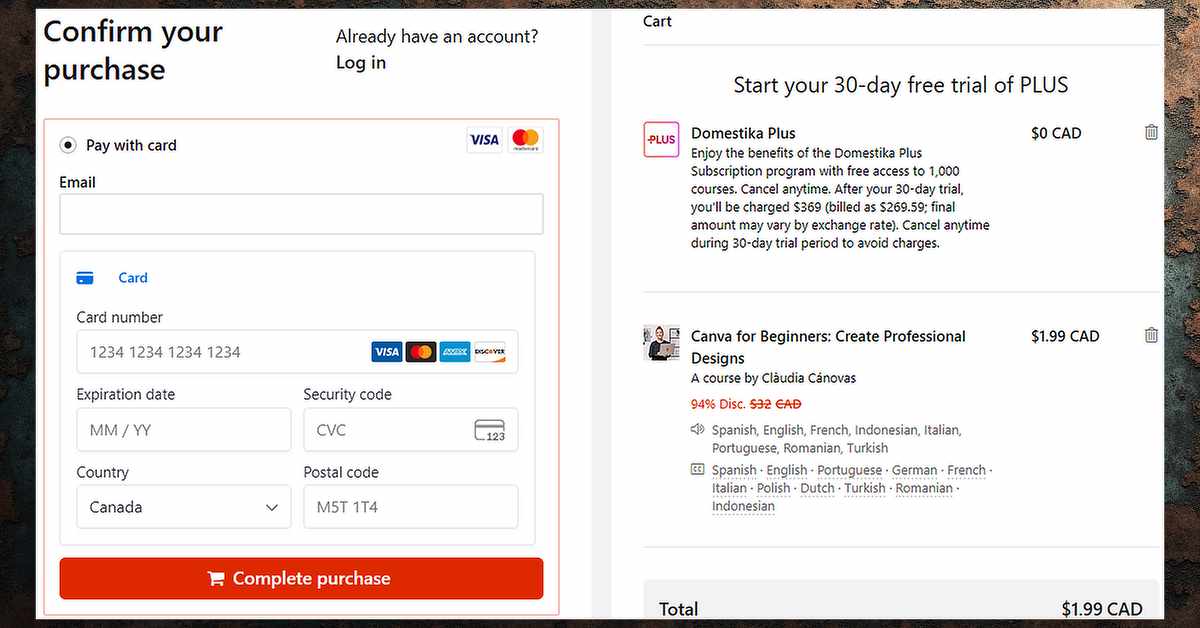
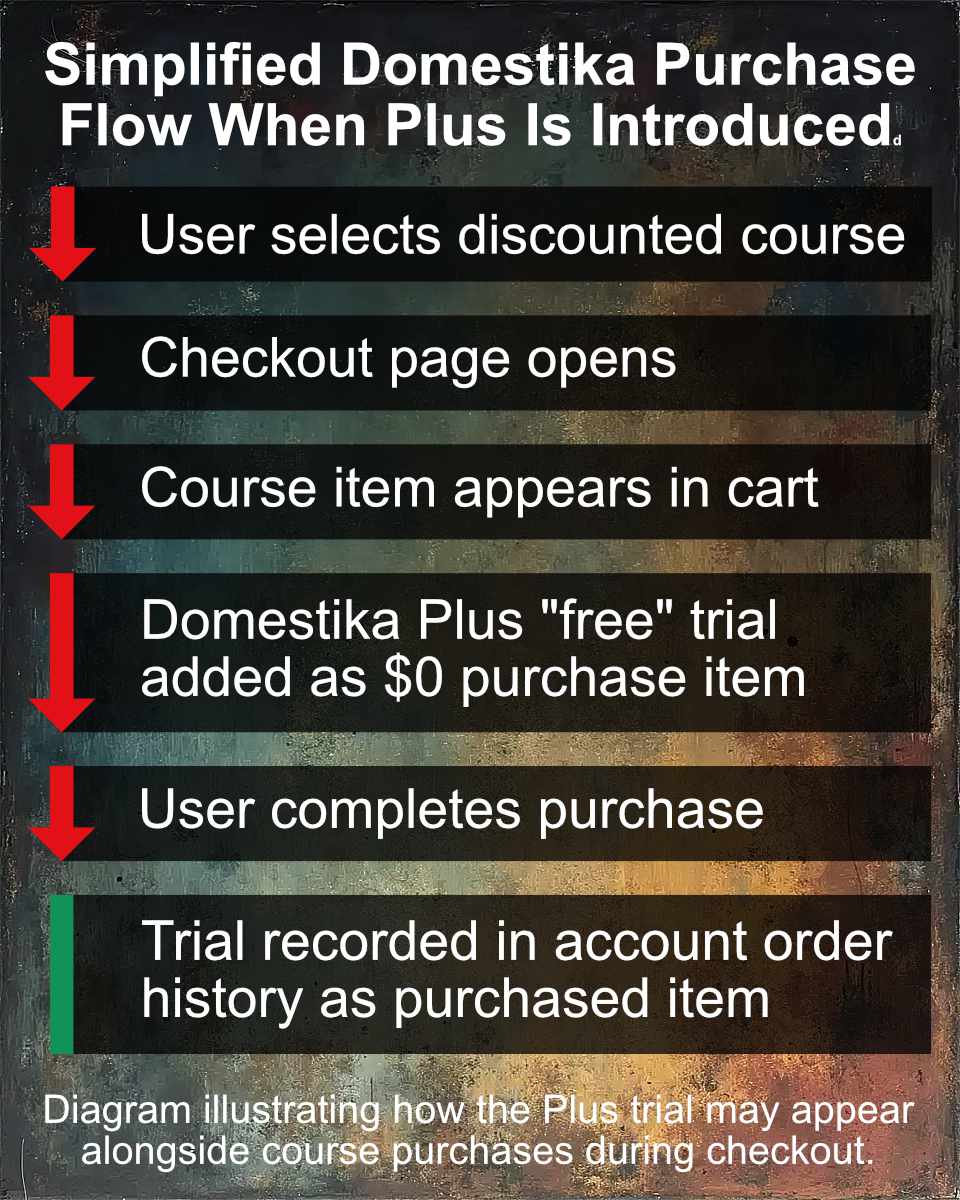
When purchasing certain discounted courses on Domestika, the checkout process often introduces two separate items in the cart:
The discounted course
A Domestika Plus free trial
From a technical standpoint, the Plus trial appears as a separate purchase item rather than simply a feature attached to the course.
This matters for several reasons.
First, it changes how the purchase is structured in the system. Instead of being presented purely as a promotional add-on, the trial behaves like an additional product added to the cart.
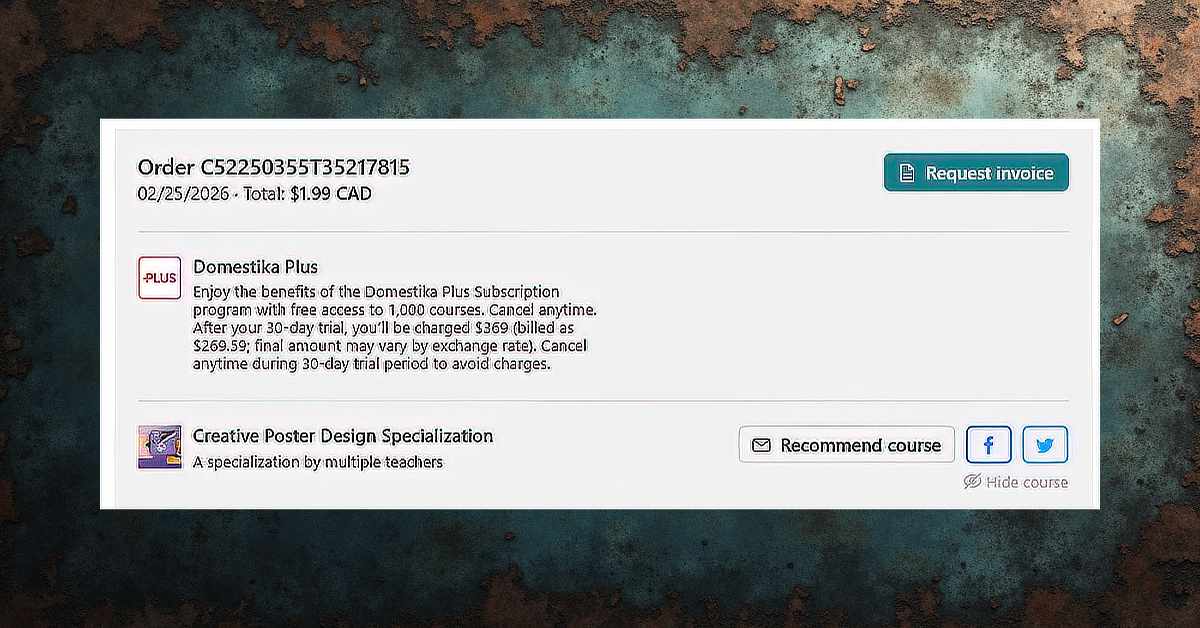
Second, the trial can appear in order histories and purchase records, which reinforces the idea that it is treated as a transactional item rather than only a temporary access benefit.
Note: I used AI to help come up with descriptive text for accessibility on the above image of the checkout, The way AI interpreted it For demonstrates that the structure of how the 30 day free trial is bundled with the discounted course may be unclear for users. “On the right, a cart summary shows a 30-day free trial of Domestika Plus priced at $0 CAD, followed by a note about a $369 charge after the trial unless cancelled. Below it, a discounted course titled “Canva for Beginners: Create Professional Designs” is listed for $1.99 CAD, with a total of $1.99 CAD.”
It may appear as a purchase for a discounted course that includes a free add-on with no further financial obligation. There is nothing in the cart that shows the trial is an active yearly subscription starting at the time of purchase with billing delayed for 30 days.
Conditional Messaging in the Interface
Another factor complicating the situation is how the interface presents pricing and membership options.
Certain purchase buttons and pricing displays appear to be conditionally rendered, meaning they change depending on whether a user is logged in, eligible for a promotion, or interacting with a Plus-related offer.
This dynamic behaviour can make it difficult for users to understand exactly what they are agreeing to during checkout, particularly when promotional language and subscription terms appear together.
From a design standpoint, conditional interfaces are common in e-commerce platforms. However, when subscriptions and one-time purchases are combined in the same flow, clarity becomes especially important.
When a subscription appears as a cart item alongside a discounted course, the purchase structure becomes more complex than the promotional messaging suggests.
During testing of the purchase flow, several interface elements appeared to change dynamically depending on promotion eligibility and account state, suggesting that parts of the checkout interface are conditionally rendered.
The Role of Promotional Urgency
Domestika also frequently runs large promotional campaigns with countdown timers and “sale” banners across the site.
These sales typically advertise deep discounts on individual courses, which can create the impression that the purchase is primarily about obtaining a course at a reduced price.
When a subscription trial is introduced within the same flow, the promotional framing may overshadow the subscription component of the transaction.
This doesn’t necessarily indicate intentional deception. But it does create an environment where the relationship between the discounted course and the Plus trial may not be immediately obvious.
Why This Distinction Matters
If Domestika’s public explanation is that misunderstandings are primarily caused by user confusion, then the design of the purchase flow becomes an important part of the discussion.
When:
A trial appears as a cart item
Promotional discounts are heavily emphasized
Interface elements change dynamically
Subscription language appears alongside course pricing
…the resulting experience can become difficult for users to interpret.
Understanding that system-level interaction is essential when evaluating reports of unexpected subscription charges.
The Consent Mismatch
During technical testing of the checkout process, I also discovered something unusual. Domestika’s frontend code contains explicit billing acknowledgment language for the Plus trial — wording that reads like a direct consent statement about the annual charge after the trial period.
However, this exact language does not appear in the checkout interface itself. Instead, the page displays a different disclosure paragraph while the purchase button only references acceptance of general site policies. I’ll be documenting this discrepancy in more detail in a separate technical analysis post later in this series.
What This Series Examines Next
This post focuses on the gap between public explanations and observable website behavior.
The next installment in The Domestika Plus Review Files takes a closer look at one specific technical detail that raises additional questions:
Why the Domestika Plus free trial appears as a cart item and purchase record entry.
That behaviour may seem minor at first glance, but it reveals important clues about how the subscription is implemented within the platform’s checkout system.
Unexpected Domestika Plus charge? You’re not alone.
During my research into the Domestika Plus subscription issue, I discovered a Facebook group where affected users are comparing experiences and documentation. The group, “Domestika-Class Action Lawsuit,” was created by community members who believe they were charged unexpectedly.
I’ve shared some of the technical findings and other documented observations from this investigation with the group, but I am not affiliated with its administration.
If you experienced unexpected Domestika Plus charges, it may help to compare your experience with others in the group.
Consumer Protection Starts with Careful Review
This post is part of The Domestika Plus Review Files, a structured review of the Domestika Plus subscription system.
The goal is not accusation, but alignment — between representation, implementation, and user experience. When those elements conflict, documentation matters.
Transparency benefits everyone.


0 Comments