Home > Blog > Scam Alerts > How Asking Questions Exposed a Design Scam

Scam Alert: The “Door Supply” Logo Inquiry — Why Asking Questions Protects You

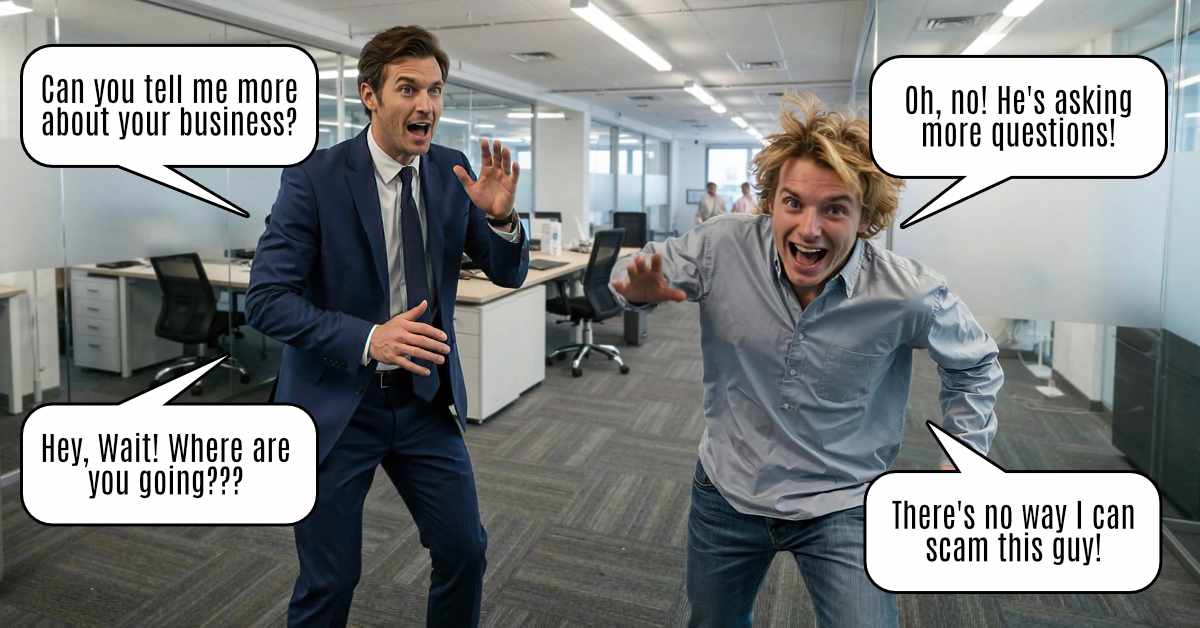
The image is a humorous staged photo set in a modern office. On the left, a man in a suit is speaking energetically with his hands raised, while another man on the right, dressed casually in a light shirt and jeans, is running away with a panicked expression. There are speech bubbles over each man: The man in the suit says: "Can you tell me more about your business?" "Hey, Wait! Where are you going???" The man running away says: "Oh, no! He's asking more questions!" "There's no way I can scam this guy!" The image humorously suggests that asking detailed questions can expose scammers.
“Asking the right questions can send scammers running — don’t be afraid to dig deeper!”

Every so often, artists and designers get messages that sound promising — someone who “found your portfolio,” praises your work, and offers a generous budget. But sometimes, what looks like a business opportunity is actually a scam in disguise.

I had a logo design inquiry recently. The first message from “Branham,” as he called himself, was quite vague. No company information at all — just a niche (“door supply”), a big budget, and a general direction for the logo. I knew it was a scam immediately when he said he was “impressed” by my portfolio on my website. My Instagram feed doesn’t feature any logo design work — my focus these days is on art and pattern design, not branding. That alone told me he hadn’t looked very closely.

Still, I decided to investigate further to see what he’d say if I asked for more information. His Reply was full of red flags.

The Red Flags

  • No verifiable business information
    “Branham” emailed me from a Gmail account with no company website or LinkedIn profile. “B&E Door Supply” didn’t show up anywhere online — not even as a placeholder domain. As Indeed’s guide on spotting fake job postings points out, lack of a digital footprint is one of the clearest early warning signs.

  • Cheque-only payment
    He insisted on paying by cheque “through their financial management team.” This is a major red flag. Overpayment scams often start this way — the scammer sends a fake check, it clears temporarily, and then bounces later, leaving the victim liable for the amount. Freelancers Union has an excellent breakdown of this exact scam pattern.

  • Requests for personal information
    I was asked for my full name, address, and phone number to “process the cheque.” These are exactly the details scammers use for identity theft or further targeting.

  • Excuse for no video or phone call
    “Branham” claimed to have a “hearing issue” and could only communicate in writing. This line has been used word-for-word in numerous freelance scams to avoid live verification. It’s common in many scam types for the same reason.

  • Overly polished business description
    The long “About Us” section he sent was clearly AI-generated or copied. It was packed with generic phrases like “trusted provider,” “cost-effective solutions,” and “long-term value.”

How I Responded

Here’s what I wrote back:

“For security reasons, I only accept electronic payment through verified business invoicing platforms such as PayPal Business or bank transfer. I cannot accept cheque payments.

I would also suggest we have a written contract for both of our protection. It ensures everything is agreed to in writing and establishes trust by keeping our agreement transparent and clear while managing expectations for us both.”

I kept it polite and professional — even wished him well with his hearing issue — but I stood firm on verified payment and a written contract.

And just as I expected, he didn’t reply.

Why Scammers Disappear When You Ask Questions

Scammers rely on vagueness and speed. They want you to act before you think. When you start asking detailed, professional questions — or require things like verified payment and contracts — they realize you’re not an easy target and quickly move on.

It’s not confrontation; it’s confidence.

A legitimate client will respect your boundaries. A scammer will vanish.

If you need a refresher on identifying red flags, ClearVoice offers a concise checklist that every freelancer should read.

Lessons for Creatives

  • Never accept cheques from new clients. Use traceable, secure methods only (PayPal Business, Stripe, direct bank transfer).

  • Ask for verification early — company name, website, and business email should all match.

  • Propose a written contract. Real clients won’t object.

  • Stay polite, but firm. Professional boundaries protect both parties.

Final Thoughts

Asking questions upfront isn’t rude — it’s smart business. It saves you time, protects your identity, and helps you build trust with legitimate clients.

Remember:

Real clients don’t vanish when you ask real questions.

Stay alert, stay professional, and keep creating safely.

Further Reading & Resources

What to Do If You’ve Already Been Scammed

If you think you may have fallen for a similar scheme or provided personal information to a suspicious contact, act quickly. Here are official resources to help you report and recover safely:

Canada

United States

Other Regions

You can also forward suspicious emails to your provider’s abuse address (e.g., abuse@gmail.com for Gmail).

More From Art and Design By Teresa Cowley
A person wearing a hooded jacket is silhouetted against a large computer screen. The screen displays a keyhole symbol in the center with a cloudy sky visible through it. Surrounding the keyhole are lines of code and digital data radiating outward. The scene is illuminated with a blue glow, emphasizing the technological and cyber-centric theme.
The Domain Disk Quota Scam
Watch out for the "Your Domain Has Reached Its Disk Quota" scam! Learn how to spot and stop phishing...
The image shows a large, intricately designed mural on a building's facade, surrounding a central set of double doors. The mural features an Art Deco style with bold, symmetrical patterns and stylized plant motifs. The color palette includes shades of orange, yellow, green, and blue. The double doors, framed in dark blue or black, have a matching geometric design with radiating lines in similar colors. The upper part of the mural features curved, sunburst-like patterns and additional floral elements.
Art Deco Elegance: Modernizing a Classic
Discover the timeless elegance of Art Deco! Explore its rich history and learn how to infuse your art...
The Art of AI Art Prompt Writing
Why Writing AI Art Prompts is an Art Form
Step into the fascinating intersection of creativity and technology with the art of writing AI art prompts....

Digital artist and graphic designer, Teresa Cowley

My name is Teresa Cowley, and I'm a digital artist and graphic designer from Vancouver Island, Canada. I focus on abstract and fantasy art as well as digital collage, and like to utilize AI art tools as part of my design process to create new, innovative pieces of art. I strive to create new, unique designs that tell imaginative stories, and I am eager to push the boundaries of what can be expressed with art and technology.

4 Comments

Avatar photo

Bria · December 22, 2025 at 9:57 am

This is so crazy, I am a graphic designer and recently had an inquiry from “Branham” about a door supply business. He too offered a generous payment for a logo design and said he had hearing issues and would be unable to communicate over the phone. Then of course the website is “under construction” because the business is new, and he can only send payment via check so he needed my mailing address.

I’m so glad I saw your article because I already had my suspicions, but this just confirms that he was attempting to scam me! Thank goodness I did not share any personal information. But wow, this was the most believable scam I’ve encountered! He even provided thorough responses to my client questionnaire and responded to my emails with personal touches.

    Digital artist and graphic designer, Teresa Cowley

    Teresa Cowley · December 22, 2025 at 6:10 pm

    That is crazy, Bria! I’m so glad my post helped you! It really is wild how tricky scammers can get. But your instincts told you something wasn’t quite right even if it sounded believable at first. If something seems off about a potential client, even when they’re responsive to questions, a bit of Googling can help you spot red flags.

Avatar photo

Máy tính lương · November 6, 2025 at 9:31 pm

Teresa, excellent breakdown! Its funny how scammers think hearing issue is such a foolproof excuse – maybe they should try my AI told me you were legit? But seriously, your points are spot on. Requiring verified payment and contracts isnt being difficult, its just common sense in this jungle! Gotta love how the real clients just respect your boundaries and move on smoothly, while the scammers vanish faster than a fake cheque in a bank. Keep up the great work, and remember, if they dont reply after you stand firm, just smile and think, Another AI-generated profile bites the dust! 😉

    Digital artist and graphic designer, Teresa Cowley

    Teresa Cowley · November 7, 2025 at 5:13 pm

    Thank you, Máy! As terrible as scammers are, it’s fascinating in a way to see what approach each one uses. They might use the same tactics over and over but their stories and excuses might be different. Asking questions and using professional business practices is the best way to make sure you’re dealing with someone who’s legit. A real client isn’t going to run away and will more than likely appreciate the questions because it shows you care about their project. I feel it’s very important to expose scams, which is why I cover them on my blog and will continue to do so.

Leave a Reply to Máy tính lương Cancel reply

Avatar placeholder

Your email address will not be published. Required fields are marked *