Home > Blog > Art and Design Inspiration > Spirals in Art: A Timeless Tapestry

Exploring the Beauty of Spirals in Art and Design

A digital hand drawn pattern of spirals and swirling lines in black on a textured off white background.
I’ve been doing a lot of doodling by hand with pen and paper, but this one was done on my computer using my mouse. Some of the lines are a bit awkward but that doesn’t concern me really. When I doodle, I’m not going for perfection. It’s all about the act of being creative. I've placed it over a textured background so it won't blend in with the background of my site as much.

As I’ve recently rekindled my love for hand-doodling, I’ve found myself mesmerized by the elegance of spirals. There’s a unique satisfaction in the motion of the pen or pencil gracefully gliding over the paper, bringing to life the captivating spiral design. But beyond the tactile joy, it’s the profound symbolism encapsulated within these spirals that truly intrigues me.

Ancient Roots: Spirals Across Cultures

Spirals are not a recent trend; they boast an ancient lineage deeply embedded in various cultures worldwide. Symbolizing growth, evolution, and the cyclical nature of life, spirals also embody harmony, balance, and the interconnectedness of diverse elements. Their continuous and flowing form allows them to take on different meanings in various cultural and contextual settings.

A Journey Through Art History

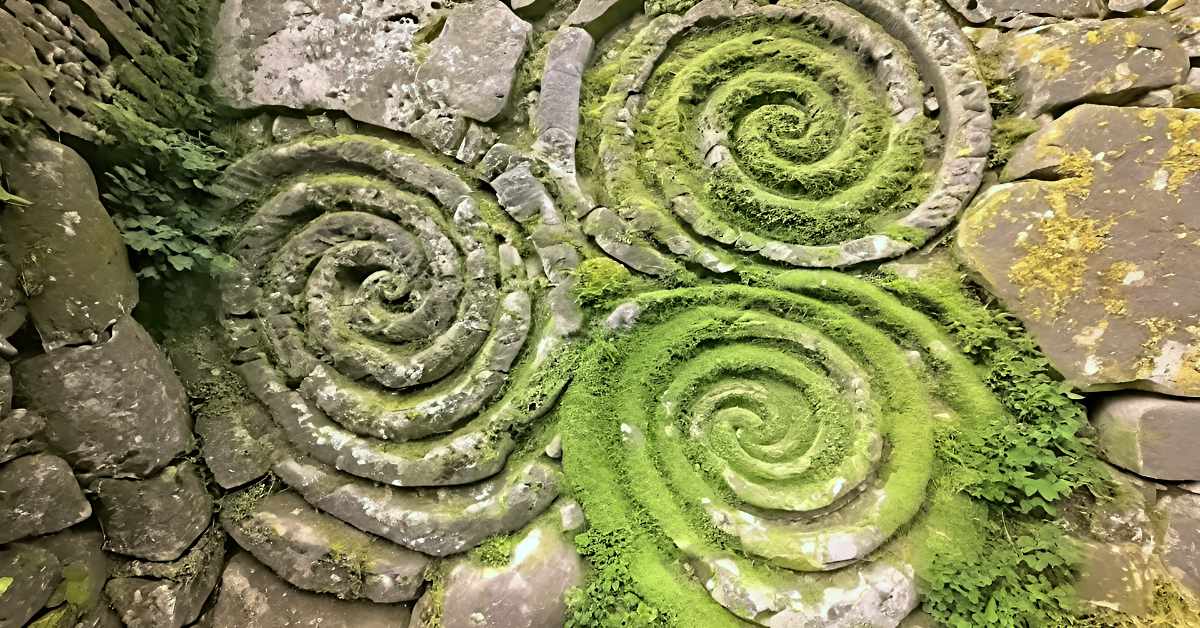
Three large spiral designs carved into stone. There is a mossy coverage over a part of the design but it doesn't obscure it.
I was trying to find an image of the three spirals design carved on the wall of the Newgrange tomb in Ireland, but couldn’t but couldn’t find any I was able to use. I always respect people’s copyright. So this image was generated with AI and although it somewhat resembles the original, it’s not historically accurate. I have an article linked below that does have an actual photo of the design.

The rich history of spiral designs in art stretches back to prehistoric times, with early examples gracing megalithic structures like the Newgrange passage tomb in Ireland, built around 3200 BCE. Spirals weave their way into the intricate decorative motifs of ancient Greek and Roman art, particularly evident in the mosaics of Pompeii.

Medieval art embraced spirals as symbols of growth and evolution, prominently featured in illuminated manuscripts and architectural details. The Renaissance era witnessed artists like Leonardo da Vinci delving into mathematical concepts related to spirals in their creative endeavors.

Spirals Across Centuries: From Art Nouveau to Contemporary Design

A portrait of a woman framed on either side by stylized leaves that curve into spiral. on the ends. In each of the corners there’s is a squirrel sitting on a curved leaf.
An art nouveau style image from an antique book illustration showing the use of spiral designs. “This is a British Library digitized image from page 231 of Poems on several occasions. Published [with a dedication, in verse] by Mr. Pope. (Visions [in prose], published in the Spectators, etc.)" From British Library online archive of public domain images which can be found on Flickr.

The allure of spirals endured into the 19th and 20th centuries, finding prominence in the Art Nouveau movement and later in abstract and Op art. Noteworthy examples include the mesmerizing spiral staircase in the Vatican Museums and the groundbreaking works of artists such as Gustav Klimt and M.C. Escher. Spirals persist as a timeless and versatile motif, continuing to captivate contemporary artists and designers alike.

In conclusion, the humble spiral transcends time and cultural boundaries, weaving its intricate symbolism through the tapestry of art history. As I continue my doodling journey, I can’t help but appreciate the depth and versatility that spirals bring to the canvas, embodying the essence of growth, balance, and the interconnected rhythms of life.

More from Art and Design By Teresa Cowley
Six thick, vertical paint swatches are applied side by side on a white surface. From left to right, the colors are: dark mauve, olive green, chocolate brown, mustard yellow, brick red, and royal blue. The paint has a textured, brushstroke appearance.
November 2025 Colour Trends for Artists & Designers
November’s colour trends bring bold blues, moody reds, and cozy earth tones into the spotlight — perfect...
The image shows wooden Scrabble-style tiles scattered in a pile. Five tiles in the center spell out the word "DREAM" in black, uppercase letters. Each tile has a small number in the lower right corner indicating its point value, such as "D" worth 2 points and "M" worth 3 points. The surrounding tiles are blank or face down, creating a textured wooden background.
Effective Ways for Creatives to Boost Visibility
Ready to boost your creative career? This post dives into actionable tips for artists and designers to...
A mannequin with short auburn hair is dressed in a sleeveless top featuring a vibrant abstract design with swirling patterns in green, yellow, orange, and black. The background consists of an artistic composition resembling a peacock feather motif, with flowing shapes in blue, green, and earthy tones, accented by circular golden-brown textured elements. To the left, there is a hint of a leopard-print pattern, blending into the scene.
Wearable Art: Butterfly & Animal Prints
Discover the magic of my new wearable art collection, where butterfly wing patterns meet animal prints...

Digital artist and graphic designer, Teresa Cowley

My name is Teresa Cowley, and I'm a digital artist and graphic designer from Vancouver Island, Canada. I focus on abstract and fantasy art as well as digital collage, and like to utilize AI art tools as part of my design process to create new, innovative pieces of art. I strive to create new, unique designs that tell imaginative stories, and I am eager to push the boundaries of what can be expressed with art and technology.

0 Comments

Leave a Reply

Avatar placeholder

Your email address will not be published. Required fields are marked *